Tuesday, January 26, 2016

Vagabond Dreams


Book #3: Vagabond Dreams
Author: Ryan Murdock
Rating: Might be a top ten book for me. An absolute must read. (5 stars)
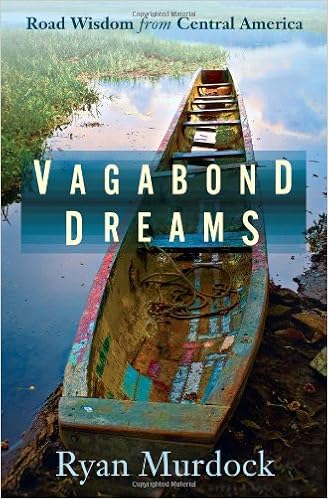

About halfway through this book I started underlining (scratch that... this started on page 40). A sentence, full paragraphs, some in pen, some in pencil. My interest in this book far outweighed by OCD tendencies to never write in a book, let alone in pen. Instead of reviewing this awesome book, I've decided to provide some of my favorite lines that have helped me realize that I need to live for me and not other's expectations of me and that sometimes, it's okay to be uncomfortable. I'm thankful that Ryan Murdock traveled through Central America so I could learn through his experiences!


"We must come to understand that our worldview is not right for all places and all times; that there's room for diversity, for other ways of living and seeing" (p.40) I am thankful for parents who encouraged me to explore the world; whether it was sending me to college, paying for a trip to Italy, or to move to a diverse part of the U.S. Although I would not call myself "well-traveled", I would say I have an appreciation for diversity and different cultures. I have also learned a great deal about culture through my marriage. There is comfort in living the life you know, but as Murdock states, "it is not right for all places and all times". 

"I came from a place where life wasn't hard enough to demand greatness of individuals. And so in order to grow, I had to go where it was." (p. 64) This one hit me hard! I've had a simple life; I've always had a roof over my head, foot on my plate, a loving family, an education, and now a stable job. The hardships I've had pale in comparison to what others around the world have had to live through. Perhaps if I've had the opportunity to experience more I would have grown up in a different way. I also teach in an area where many of my students/athletes have not been given the opportunity to live a difficult life. I say opportunity because so many parents want to shelter their children from the difficulties life has to offer. Perhaps it's because they don't want their children to fail, but, in my opinion, this act is preventing them from truly growing. 

"Humanity is forever grasping at certainty in an uncertain world. We get a secure job that's supposed to last for life. We buy a house and settle in for the long haul. We marry until death do us part. But life isn't like that. Uncertainty is the norm." (pp.95-96) Oh man. This. Just this. It speaks for itself... 

"We're always doing, doing, doing. It's an incredible change to make the shift to doing nothing. But if you can successfully make that shift, something happens on a deeper and more profound level. What mattered so much doesn't matter anymore." (pp.187-188) Having been stuck inside for five days because of a snowstorm, I can, in a way, relate to this. I've actually been cooking dinner, which never happens when I have to work the next day. I was asking my husband why he thinks it is...I live my life based on my worry of what will happen rather than just letting it be what it is. I'm so worried about not having time to relax in front of the TV that I don't take the time to do things that truly matter. What a horrible way to live. 

"Growth is not a straight-line progression, or a steady climb. It's a series of backward ratchets that build momentum for great leaps forward." (p.212) Yes. 

"I came to realize that the trick lies in finding a place that suits you, rather than crushing yourself to fit into a space. It's a realization you can come to only when you truly understand how large and varied the world is - how broad your opportunities are - if only you have the courage to go." (p. 291) This speaks volumes in every aspect of life; from where you live to what you do for a living. It's difficult to try something new and find the place for you, but you must have the courage to try. I've been teaching for 7 years and I've become comfortable. But as Murdock says, 'comfort has made zombies of us all'. Am I truly living if I allow myself to remain comfortable. I started thinking.. what is comfortable? As defined on dictionary.com, comfortable is 'physically relaxed and free from constraint', 'free from financial worry; having an adequate standard of living'. If we agree with what Murdock says, being comfortable can actually constrain us ('severely restrict the scope, extent, or activity of'). What a contradiction! And do we really want to live a life with an adequate standard of living or do we want to live a whole life; one far beyond just 'satisfactory' or 'acceptable'. We must push beyond satisfactory and move toward exceptional! 

"Life's spark is smothered by routine, by the grind." (p.337) This can only be explained the Calvin and Hobbes cartoon to the left, which interestingly enough was found on a website to teach students about routine and how to 'make them more bearable'. Yuck! The lesson plan includes looking at Tiger Woods's routine, with a side note that if being taught to adults, include Tiger's affairs as part of his routine...Perhaps the lesson should discuss how routines cause us to make bad decisions? Who knows, I'm not an expert! 

"We come to know ourselves through how we reflect off other people. They are our social mirrors. And so the vast majority of us live inadvertent lives trapped in boxes, not all of our own making." (p.343) And finally, the quote that will stay with me. I will continue to reflect on this one for quite some time.

Tuesday, January 19, 2016

Make Today Count

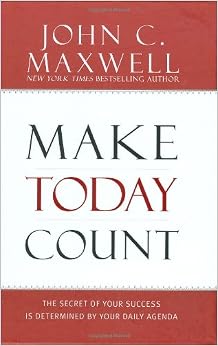
Book #2: Make Today Count
Author: John C. Maxwell
Rating: Must read. Will keep by my bed and read often! (5 stars)

I had intended to read another novel, but this book caught my eye. My husband purchased this book at some point, but has yet to read it. We are both very reflective people and if you are the same, this book is a must read. John Maxwell has an interesting background and has dedicated his life to his faith and to improving the lives of the people around him. The book is broken into twelve chapters that he refers to as the "daily dozen"; areas to focus on to make the most of each day. The "daily dozen" are attitude, priorities, health, family, thinking, commitment, finances, faith, relationships, generosity, values, and growth.

The chapters I connected with most are priorities, commitment, and values. Because I am innately self-reflective and spent six years at The University of Rochester whose motto happens to be Meliora (ever better), I often have a hard time being content. My good friend and I took a road trip this weekend and she brought up the fact that our society is much more focused on happiness; we must be happy with our jobs, with our marriage, with our friends and, if we're not, move on and find something better. I also feel that this mindset is promoted with our material belongings - we are always looking for the newest phone upgrade, the next best computer, a higher resolution TV, and the latest style in fashion. I'm starting to recognize that this mindset does not actually promote happiness, rather it encourages us to focus on what could be. Bad day at work? Find a new one. Fight with your spouse? Maybe you shouldn't be married. Instead, we must look at our priorities and values and use these to decide what we are most committed to.

In order to prioritize, John Maxwell suggests that we ask ourselves three important questions: What is required of me?, What gives me the greatest return?, and What gives me the greatest reward? Maxwell states, "if you do only what you must and what is effective, you will be highly productive, but you may not be content". This is especially important when he discusses the need to invest in the right people daily. It has taken me a long time to realize what Maxwell points out in his book: "you want to treat everyone with respect and try to have a good, positive relationship with everyone. But you should not spend time with everyone equally". Instead, he says to consider who you want to invest in and ensures us "you will never regret it". This is something we people pleasers must learn to do!

One of the things I struggle with most is deciding when it's time to move on. Yes, we all have bad days at work or in our relationships, but when do too many bad days overcome our commitment to the cause. First, Maxwell suggests, we must look at what motivates our commitment; is it external or internal? Those who focus on external (such as myself), allow external conditions to guide their decision to remain committed. On the other hand, "people who base their actions on the internal usually focus on their choices". Maxwell goes on to discuss that we cannot control the circumstances nor other people's choices, but we can control our choices. If we instead make choices based on our commitment to a cause instead of deciding whether to be committed based on our choices, we will have a higher level of success. As someone in a service field (a teacher and a coach), I often find that I am "interested" in what I do rather that "committed". I believe it is especially difficult for those in a service field because you feel committed to the people (or students in my case) that you work with that you often feel guilty for wanting to leave. How do we decipher between guilt and commitment?

This idea was reinforced when Maxwell quotes Ken Blanchard, "When you're interested in something, you do it only when it's convenient. When you're committed to something, you accept no excuses, only results". After reading this quote, I've had a hard time determining what I am truly committed to. At a minimum, my marriage and raising my step-son. As far as my career, I'm not so sure anymore!

Last, but not least, Maxwell discusses the need to identify our values. The most important aspect of this chapter is recognized when Maxwell states, "For me to be successful, my values - not my feelings - need to control my actions". This is a very difficult concept for someone who is emotional and almost too in touch with their emotions.

After reading this book, I have learned that there are several next-steps I must take.

  1. Focus on my values. Without establishing my values, I cannot determine my path in life.
  2. Decide what is important to me. Once I've established what is required of me to be a good wife, step-mom and employee, determine what gives me the greatest return, but also what gives me the most reward?
  3. What am I interested in versus what am I committed to. 
I recently watched an excellent TED Talk that I would highly suggest to anyone struggling with hard decisions. In this TED Talk, Ruth Chang states, "When we create reasons for ourselves to become this kind of person rather than that, we wholeheartedly become the people that we are. You might say that we become the authors of our own lives."

This talk and John Maxwell's book very much echo one another. I would highly suggest reading Make Today Count and for some additional help in creating your path, watching How to Make Hard Choices. They are both worth the while! 


Sunday, January 10, 2016

The Year We Left Home

Book #1: The Year We Left Home
Author: Jean Thompson
Rating: Quick read, but no real plot. (2.5 stars)

I'm not sure where this book even came from. I think my husband may have bought it, although after reading it, I doubt he would have any interest in reading it himself. The Year We Left Home was a quick read but lacked any sort of plot or resolve. Although you follow the characters through their life from 1973-2003 you only learn about them on a superficial level. It appears to highlight the dysfunction most families have, but are often unwilling to talk about; a father who is an alcoholic, a son with little direction who ends up divorced with two children, and two grandchildren whose lives are discussed perhaps only to show how the dysfunction has been passed down. I was hopeful that the last twenty pages would have some sort of plot twist to make the 325 page book worthwhile, but, unfortunately, I was waiting for nothing. I'm even confused why the title is The Year We Left Home considering the book lasts 30 years.

What I did like about this book is that it was honest. Every family has its issues, but in the end family is family and you'll do whatever it takes to support them. And, most importantly, sometimes the ones who don't appear to care, actually care the most. 


Goodreads Reviews

"Pretentious piece of crap. Supposed to be the summer darling of the intellectual elitists. The whole book is nothing but a series of vignettes about being miserable. The whole family takes a turn on the misery train where I get to be in the caboose. The name of this book should have been My Life Sucks More Than Yours." -Amy July 21, 2011 (1 star)

"This book wasn't terrible, but there was no point to it and no ah-ha moment. If the author had a message to send, it was lost in the fragmented stories within." -Cheryl January 5, 2015 (2 stars)

"Insightful and informative regarding the life of a typical Midwest family." -Joyce June 2, 2013 (3 stars)

"Family, country, happiness, tragedy, and just plain life all work together to tell the story, no the history, of this family. From its beginning on the farm to the computer era, change is inevitable - some positive some not. What is special about these characters is there ordinariness. This family could be yours or mine." -Susan March 26, 2013 (4 stars) 

"If you need fairy tales with happy characters and happy ending, best leave this book on the shelf. But if you understand that people are flawed but still have interesting stories worth paying attention to, you'll probably enjoy it. I did. Will surely read it again." -Susan November 20, 2015 (5 stars)