Author: John C. Maxwell
Rating: Must read. Will keep by my bed and read often! (5 stars)
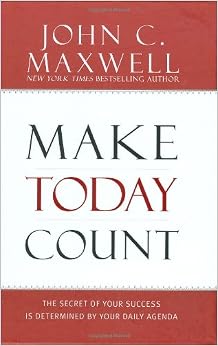
The chapters I connected with most are priorities, commitment, and values. Because I am innately self-reflective and spent six years at The University of Rochester whose motto happens to be Meliora (ever better), I often have a hard time being content. My good friend and I took a road trip this weekend and she brought up the fact that our society is much more focused on happiness; we must be happy with our jobs, with our marriage, with our friends and, if we're not, move on and find something better. I also feel that this mindset is promoted with our material belongings - we are always looking for the newest phone upgrade, the next best computer, a higher resolution TV, and the latest style in fashion. I'm starting to recognize that this mindset does not actually promote happiness, rather it encourages us to focus on what could be. Bad day at work? Find a new one. Fight with your spouse? Maybe you shouldn't be married. Instead, we must look at our priorities and values and use these to decide what we are most committed to.
In order to prioritize, John Maxwell suggests that we ask ourselves three important questions: What is required of me?, What gives me the greatest return?, and What gives me the greatest reward? Maxwell states, "if you do only what you must and what is effective, you will be highly productive, but you may not be content". This is especially important when he discusses the need to invest in the right people daily. It has taken me a long time to realize what Maxwell points out in his book: "you want to treat everyone with respect and try to have a good, positive relationship with everyone. But you should not spend time with everyone equally". Instead, he says to consider who you want to invest in and ensures us "you will never regret it". This is something we people pleasers must learn to do!
One of the things I struggle with most is deciding when it's time to move on. Yes, we all have bad days at work or in our relationships, but when do too many bad days overcome our commitment to the cause. First, Maxwell suggests, we must look at what motivates our commitment; is it external or internal? Those who focus on external (such as myself), allow external conditions to guide their decision to remain committed. On the other hand, "people who base their actions on the internal usually focus on their choices". Maxwell goes on to discuss that we cannot control the circumstances nor other people's choices, but we can control our choices. If we instead make choices based on our commitment to a cause instead of deciding whether to be committed based on our choices, we will have a higher level of success. As someone in a service field (a teacher and a coach), I often find that I am "interested" in what I do rather that "committed". I believe it is especially difficult for those in a service field because you feel committed to the people (or students in my case) that you work with that you often feel guilty for wanting to leave. How do we decipher between guilt and commitment?
This idea was reinforced when Maxwell quotes Ken Blanchard, "When you're interested in something, you do it only when it's convenient. When you're committed to something, you accept no excuses, only results". After reading this quote, I've had a hard time determining what I am truly committed to. At a minimum, my marriage and raising my step-son. As far as my career, I'm not so sure anymore!
Last, but not least, Maxwell discusses the need to identify our values. The most important aspect of this chapter is recognized when Maxwell states, "For me to be successful, my values - not my feelings - need to control my actions". This is a very difficult concept for someone who is emotional and almost too in touch with their emotions.
After reading this book, I have learned that there are several next-steps I must take.
- Focus on my values. Without establishing my values, I cannot determine my path in life.
- Decide what is important to me. Once I've established what is required of me to be a good wife, step-mom and employee, determine what gives me the greatest return, but also what gives me the most reward?
- What am I interested in versus what am I committed to.
This talk and John Maxwell's book very much echo one another. I would highly suggest reading Make Today Count and for some additional help in creating your path, watching How to Make Hard Choices. They are both worth the while!

No comments:
Post a Comment